

New Construction vs. Resale Homes in Austin: Which Is Better for Buyers?
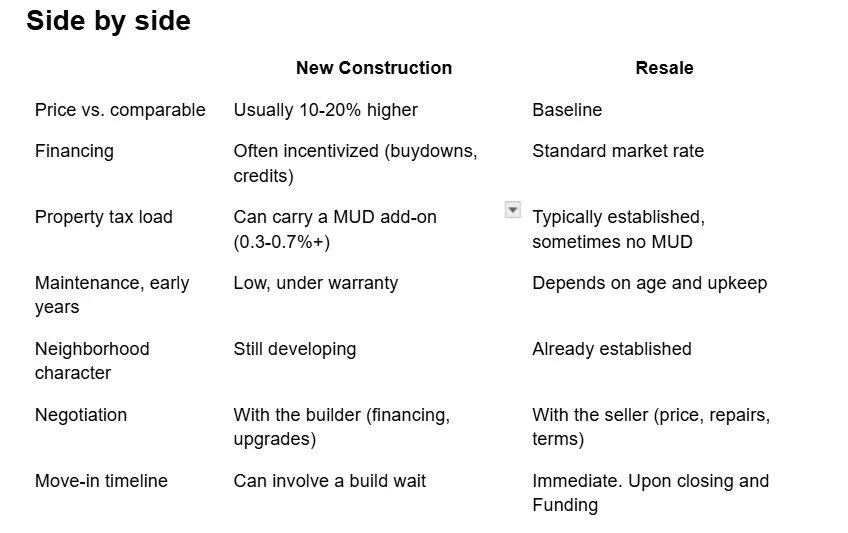
Short version: if your priority is the lowest monthly payment you can get right now and you don't mind living a little further out, new construction is probably going to win, thanks to how aggressive builder incentives have gotten. If you care more about a settled neighborhood, mature trees, and a location that won't shift under you, resale is usually the smarter play. But "probably" and "usually" aren't good enough when you're talking about the biggest purchase most people ever make, so let's actually walk through it.
I get asked this question almost every week, and it's rarely as simple as "new is better" or "resale is better." It really comes down to what you're optimizing for, and whether you've actually run the numbers or just eyeballed the price tags.
Why this question matters more than it used to
A few years ago this was almost a moot point. Resale inventory was scarce, homes sold in days, and builders had waitlists. That's flipped. New construction now makes up close to a third of all active listings in the Austin metro, which tells you everything about how much has changed. Resale sellers who locked in 3% rates during the pandemic aren't in a hurry to give that up, so a lot of them just... aren't selling. Builders, on the other hand, keep building no matter what rates do. So they're sitting on inventory, and they need to move it.
That's why you're seeing incentive packages everywhere right now: rate buydowns, closing cost credits, $10,000 to $30,000 in design allowances, even the occasional "4.99% rate!" banner outside a model home (sometimes lower for the first year or two). It's real money. But it's also, in my experience, the part buyers get most dazzled by without looking at what's underneath it.
The case for new construction
The honest upside here is real. Everything's new (HVAC, plumbing, roof, windows, insulation), which usually means a handful of boring, maintenance-free years while everything's still under warranty. You're not inheriting someone else's decades-old decisions about the kitchen layout. And if you buy early enough in the build process, you actually get to pick some of those decisions yourself.
Then there's the financing. A builder buydown can shave real money off your monthly payment, sometimes more than an equivalent price cut would. That's not a gimmick. It's genuinely one of the better tools in this market.
Here's what I wish more buyers asked before they got excited about a model home, though: what's the base price actually included? Because "homes from the $400s" rarely means the home you end up wanting. Lot premiums, upgraded flooring, extra bedrooms, a better elevation, it all adds up fast, and a to-be-built home can drift a long way from that first number by the time you're at the closing table. An already-finished inventory home is usually a cleaner comparison, since the price is set and the builder's often more motivated to move it.
And then there's the thing nobody at the sales office volunteers: a lot of these newer communities sit inside a MUD, a Municipal Utility District. That adds somewhere around 0.3% to 0.7% onto your property tax rate, permanently, to pay off the bonds that funded the roads and water lines. It's not a one-time fee. It rides along with your tax bill for years, sometimes decades. I bring this up constantly with clients because it's exactly the kind of thing that gets buried under a shiny rate buydown, and the buydown expires while the MUD tax doesn't.
The case for resale
What resale gives you that no builder can manufacture is time: mature trees, a neighborhood that's already settled into whatever it's going to be, an actual sense of place. You can drive the streets and see how people take care of their homes instead of trying to picture it from a rendering of a park that might get built in three years.
You also get to see the home's actual history: past repairs, disclosures, whether the roof's already been replaced, whether someone already sank money into the kitchen. That's information a new build simply can't give you yet, because it doesn't have a past.
And negotiating with a person is a different animal than negotiating with a builder. Sellers can move on price, repairs, closing costs, timeline. There's more room to shape a deal around what actually matters to you, whether that's cash at closing or getting them to fix the foundation issue your inspector flagged.
Which brings me to the thing I say to almost every resale buyer: don't skip the option period inspection to win a bidding war. I know the temptation is real in a competitive situation, but Central Texas clay soil is not forgiving, and foundation problems are common enough here that this isn't a hypothetical. Get the inspection. Every time.
The number that actually decides it
Here's the exercise I walk almost every buyer through, and it's the one step most people skip: stop comparing sale prices and start comparing what you'll actually pay every month. That means mortgage payment at your real interest rate (not the teaser rate that expires in year three), property taxes including any MUD add-on, insurance, and HOA dues.
Two homes priced identically on paper can land in very different places once you do this. A buydown might make new construction cheaper for the first couple of years, and then the rate resets while the MUD tax keeps going, and the math flips. I've seen it go both ways. That's exactly why I run this comparison for clients before they commit to either option, instead of letting a listing price make the decision for them.
Questions I get asked a lot
Is it cheaper to buy new construction or resale in Austin?
Honestly, it depends on the specific homes and the specific financing on the table. New construction can come with an incentive that lowers your effective rate; resale can come with a seller willing to cover closing costs or drop the price. The only fair comparison is the full monthly number: mortgage, taxes, insurance, HOA. Not the price on the sign.
Are property taxes actually higher on new construction in Austin?
Not just because it's new, but a lot of newer communities sit inside a MUD, which tacks on roughly 0.3-0.7% to the effective tax rate to cover infrastructure bonds. That can run for years. Always ask whether a specific community is in a MUD before you compare its tax bill to a resale home's.
Can you actually negotiate the price on a new build?
Sometimes, but builders would usually rather hand you a financing incentive or upgrade credit than cut the price outright. It protects their comps for the rest of the community. How much room there is depends a lot on how much inventory that builder still has to move.
Do I need my own agent if I'm buying new construction?
Yes. The person in the sales office is friendly, but they work for the builder. Having your own agent means someone's actually looking out for your side: the price, the incentives, the contract, and whether a comparable resale might be the better deal. Loop your agent in before you tour communities, since some builders have rules about representation that get messy if you show up alone first.
Should I still get an inspection on a brand-new home?
Yes, every time. New homes can absolutely have construction defects. Different trades, different subcontractors, and mistakes happen even with good builders. An inspector works for you, not the builder, whether the house is 30 days old or 30 years old.
Is new construction a better investment than resale around here?
Not automatically. Location, tax burden, lot, and what gets built around the property over the next few years matter more than whether the paint is fresh. A well-located resale in an established area can easily outperform a new build sitting in a community that's still filling in.
What's the real difference between a to-be-built home and an inventory home?
A to-be-built home lets you pick finishes and layout, but you're on the builder's timeline and exposed to price creep on upgrades along the way. An inventory home is already finished, selections already made, price already set, and often the better negotiated deal, since the builder's carrying costs on a house that's just sitting there.
Want to run your specific numbers?
If you're weighing new construction against resale anywhere in Round Rock, Pflugerville, Cedar Park, Georgetown, or greater Austin, I'd rather sit down and show you the real month-one and year-five cost on the actual homes you're considering than let a builder's flyer or a listing price make the call for you. That's the part of this I can do that most agents can't: running the tax side of it with the same license I use to protest tax appraisals, not just guessing at it.
Reach out and let's run the comparison together.
About the author: Ariel and Jeff Pine of Pine & Paul Real Estate and Pine & Paul Property Tax Consulting LLC, is a licensed real estate agent and property tax consultant (Agent #1898231) serving the Round Rock, Pflugerville, Cedar Park, Leander, Georgetown, Liberty Hill and greater Austin market.